The European Commission has just published a roadmap for phasing out animal testing for chemical safety assessments.
An analysis of its strengths and weaknesses can be found in *Nature*
Below are the principles that guided its development and the lengthy process that led to the creation of this roadmap.
The third workshop on the roadmap for phasing out animal testing for chemical safety assessments (industrial products and pharmaceuticals) was organized by the European Commission (EC) and the European Chemicals Agency (ECHA) in Helsinki and via videoconference on June 16 and 17, 2025.
All the information, videos, and presentations are available on the event page.
This workshop was the third of its kind, following those held in December 2023 and October 2024. Compared to the previous two, it provided further details on the timeline and governance.
It should be noted that this work was initiated following the European Citizens’ Initiative (ECI) “For Cruelty-Free Cosmetics—Committing to a Europe Free of Animal Testing” submitted to the European Commission in January 2023 (1.2 million signatories).
This roadmap must “chart a course to accelerate the development, validation, and implementation of non-animal methods.”
Three working groups were established:
- Human Health
- Environmental Safety
- Change Management
In addition to the numerous meetings held by these groups, 40 events (conferences, seminars, etc.) took place. Two online surveys were also conducted among stakeholders.
What does this roadmap cover?
The roadmap is expected to be about 15 pages long, with a comprehensive accompanying document. It will cover all European legislation that may require animal safety testing, totaling 15 different pieces of legislation (REACH, biocides, pesticides, pharmaceuticals, medical devices, veterinary products, food contact materials, detergents, etc.).
The recommendations will address the following points: the replacement, reduction, and refinement of animal testing in the short and medium term; steps for implementation; facilitating the incorporation of new methods into legislation; establishing an effective network for the validation and qualification of new tests; the selection of indicators to monitor progress in implementation; and the selection of appropriate organizational structures.
Note the introduction of the new concept of “qualification,” which is similar to the concept of “validation” but involves a shorter procedure (without the step of verifying interlaboratory reproducibility). However, with this simplified procedure, products could be denied entry into certain countries due to a lack of international recognition of non-animal tests.
What were the deadlines?
- Between June and September 2025, the draft project roadmap will be developed through discussions with stakeholders.
- Between September and December, the Commission is expected to approve the roadmap internally and adopt it; it is scheduled to be published during thefirst half of 2026, after which the implementation phase will begin.
- During the implementation phase, discussions will take place regarding the new technologies that need to be developed to facilitate the transition.
The Focus of the Work
The proposed model is the “three baskets” model, which outlines what is possible in the short, medium, and long term:
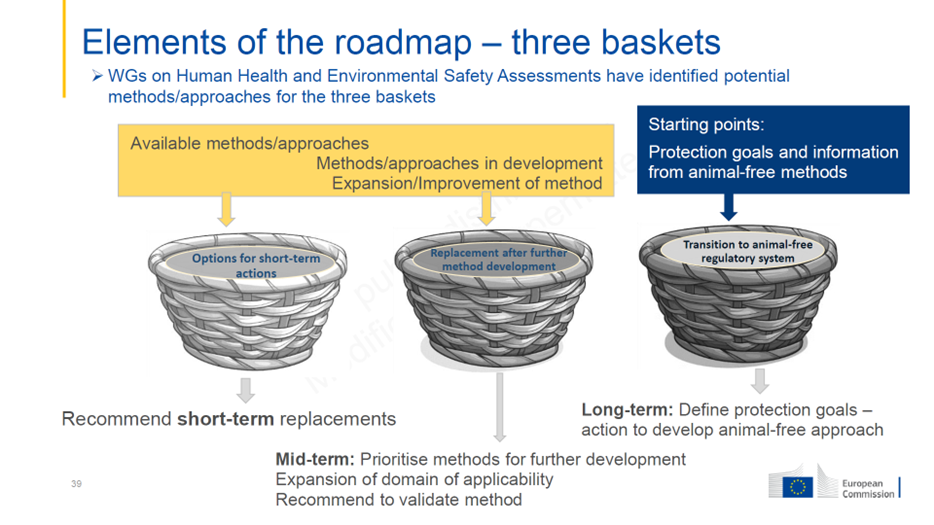
This approach is useful for moving beyond the fruitless debate between those who want to replace all animal testing with NAMs (new methodological approaches) immediately and those who argue that this will never be possible. The key is to distinguish between methods that can be used in the short term and those that still need to be developed in the medium or long term in the complex fields of toxicology, bearing in mind that a “one-for-one” replacement is not possible for most tests. A different approach is needed, summarized under the term “Next Generation Risk Assessment” (NGRA), based on a battery of in vitro and in silico tests.
Governance
Several bodies will be established, with NGOs playing a full and active role alongside industry representatives, the European Commission, European agencies, and experts in non-animal methods. A key aspect of this governance is collaboration among all the European agencies involved.
Given the number of organizations and partners involved in this process, coordination of the work is essential; this will also make it possible to take into account other initiatives such as “OSOA” (“one substance, one assessment”) and the project for a revision of the REACH regulation on chemicals.
The roadmap should specify how to coordinate all organizations and bodies. This role could be filled by the EPAA (European Partnership for Alternative Approaches to Animal Testing).
Success metrics for the roadmap and its implementation will be established in a transparent manner:
- Metrics related to engagement, knowledge sharing, and building trust
- Indicators related to test development and validation, funding, cost-effectiveness, industry adoption, and regulatory acceptance
- Indicators on barriers to adoption, efficiency, and reliability
- Indicators on the 3Rs
The Challenges and Expectations Regarding NAMs
In the first online stakeholder survey, conducted in late 2024 among nearly 200 respondents (industry representatives, NGOs, research institutes, regulatory authorities and agencies, etc.), 95% saw benefits in moving toward animal-free testing: shorter time to market, lower costs, improved corporate image, safer products, and reduced administrative burden, among others.
However, scientific obstacles remain, as does the hurdle of regulatory approval.
That said, the obstacles to the transition are not only technical but also sociocultural. It is important to build trust in NAMs and to foster mutual trust among industry representatives, scientists, government officials, and regulatory agencies.
The goal is to achieve a human-centered, animal-free approach that adopts a mechanistic understanding of toxicity (causal links between exposure, molecular changes, and adverse effects) and incorporates environmental safety considerations.
Among the short-term proposals, the idea was raised to eliminate the requirement to test certain products on a “second species,” with a view to avoiding testing on dogs in particular.
The issue of funding for validation was identified as fundamental; it constitutes a bottleneck. Several approaches were discussed, such as seeking public-private partnerships (see the example of the PEPPER platform). It was also suggested that a specific amount for the validation of non-animal tests be included in the funding allocated through European projects.
Among stakeholders, there is a wide range of expectations and priorities. For NGOs, the priority is to end the use of animals as soon as possible. For scientists, in addition to this goal, the focus is on improving safety testing for human health and the environment. Given the thousands of products that will need to be tested in the future to meet safety requirements, it will be impossible to continue with animal testing anyway. We need to change our methodology, understand the toxicity process (which differs between mice and humans), and adopt a deterministic approach.
The example of the transition already completed in the cosmetics industry was cited as a source of inspiration. The EU could be a driving force in the field of alternative testing, but the United States is already well ahead. The need to carry out the transition at the international level was emphasized.