
The BioMedical Model Hub (BimmoH) is the latest initiative of EURL ECVAM (within the Joint Research Center – JRC), launched in 2025, to address the explosion of non-animal models emerging from biomedical research. Much more than just a database, using artificial intelligence, BimmoH is designed to extract, filter and categorize scientific publications (on Pubmed) that use models based on human biology, enabling the use of non-animal approaches.
BimmoH, coordinated by JRC and Fresci, is the largest public database of scientific articles using human biology models in biomedical research, and is continually updated.
Among other applications, it is intended to update and replace the ECVAM reviews of non-animal methods by disease area.
BimmoH’s objectives and methods are detailed in this November 12, 2025 presentation.
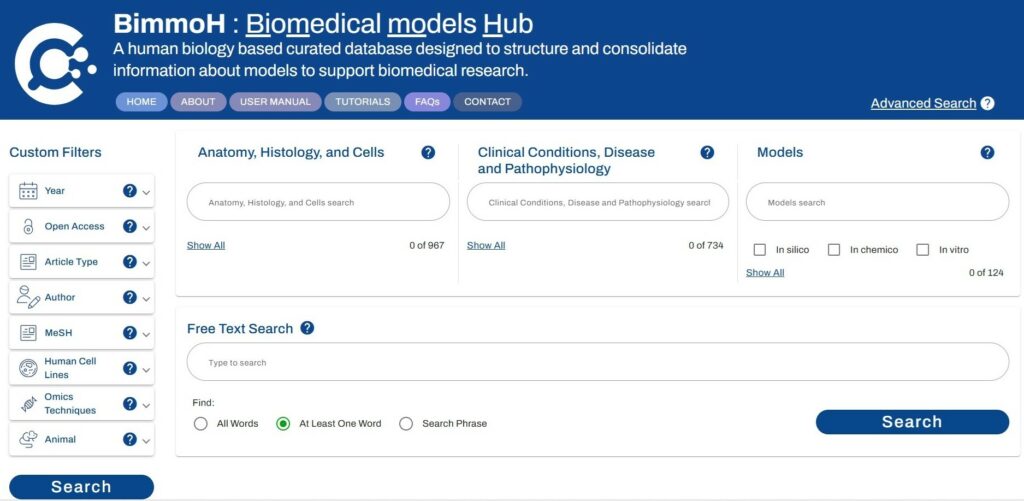
The AI sorts models into three main categories:
- Anatomy, histology and cell types (e.g. liver, brain, skin)
- Clinical situations and disease areas (e.g., cancer, respiratory diseases)
- Type of model ( in silico, in vitro (organoids, organs on a chip, etc.), in chemico)
You can also launch a free text search. However, to avoid being swamped by hundreds of publications, it’s best to also use some or all of the three categories above and/or the filters in the left-hand column: years, article type, cell lines, etc.
A query can be used to obtain a list of relevant publications very quickly.
Home page :
On the ProAnima website, read the interview with Marco Straccia, neuroscientist and founder of the FRESCI consulting agency, who delivered BimmoH (December 2025).
This database has a few limitations:
- It is based solely on the Pubmed database, which is certainly the main database for biomedical publications (and free), but there are other databases, such as “web of science”.
- Many of the publications on offer mix animal-free methods with animal testing, so the replacement is only partial.
- The tool is not yet a tool for identifying research avenues via animal-free methods on the basis of a question posed, and in this respect artificial intelligence is not yet being used to its full potential, even if we must not hide the technical difficulties of such an evolution (perhaps in a later version?).
- Other tools exist for the same purpose, i.e. to identify publications in the Pubmed database that have used animal-free research methods, but there is no coordination between these tools.
Other tools include the NAT (non animal technologies) database, developed on the initiative of the German association “Ärzte gegen Tierversuche”, or Smafira (acronym for “SMArt Feature based Interactive RAnking”), developed on the initiative of BF3R in Germany, which, for a reference article, provides similar articles in the same field and suggests articles that have developed alternative methods. These two tools also work with the Pubmed database.
In any case, BimmoH represents an important advance in access to information on non-animal methods, and deserves to be widely used by researchers.
It should be used systematically by project evaluation committees to assess alternative solutions to project authorisation requests.