
To read the article online on the Le Monde website: click here (the full article is available only to subscribers)
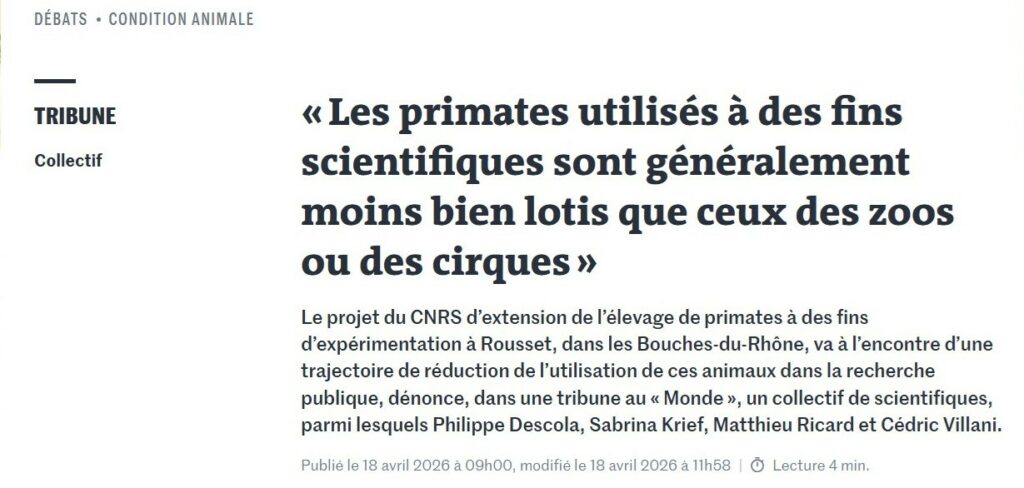
The management of the National Center for Scientific Research (CNRS) is continuing its project, launched in 2021, to expand its non-human primate (NHP) breeding facility in the town of Rousset (Bouches-du-Rhône), near Marseille. The goal is to house up to 1,800 primates there so that, starting in 2032, the center can produce 250 to 300 primates per year and sell them to French public research laboratories for scientific experimentation.
In 2023, the government decided to provide 30 million euros in funding for the project as part of the France 2030 investment plan. Despite numerous ethical objections, the stubborn determination of the project’s proponents, the CNRS, and the government reflects the prevalence in France of an outdated view of animal experimentation.
Indeed, since 2024, reservations have been raised from all sides: NGOs [ non-governmental organizations] , civil society, researchers and academics , all questioning the merits of such a project from ethical, scientific , and economic perspectives. A public consultation took place in the fall of 2025, followed by the publication of a report by the guarantor of public debate on December 16, 2025, and the opinion of the CNRS ethics committee (Comets) on January 27.
A negative image
In his conclusion, he “believes that the project ( …) “would be acceptable only under the following conditions: 1. Conduct a collaborative, multi-stakeholder scientific review; 2. Establish a clear roadmap for reducing the use of PNHs in academic research.” .
However, disregarding the recommendations, opinions, and arguments, the CNRS Provence-Corse delegation reiterated, in its response dated February 16, its intention to proceed with the project without altering its objectives or scope and without considering how to meet the preconditions set forth in the Comets opinion. Conducting public consultations and seeking the opinions of ethics committees, only to ultimately largely ignore the objections raised, conveys a negative image of the scientific community to the public and risks pushing our fellow citizens toward an anti-science attitude, which already has too many followers.
The arguments against the project are primarily ethical. Primates used for scientific purposes are generally worse off than those in zoos or circuses. Regulations stipulate a minimum area of 6 square meters per macaque in traveling shows (a practice that will be banned in France in 2028), compared to 1 square meter for animal experimentation. In Rousset, they will haveabout 2 square meters. And once transferred to the laboratories that will “use” them, some will never see daylight again. Most will then undergo experiments of varying severity and be killed prematurely.
Extremely Harmful Stubbornness
Just because research is considered useful in terms of advancing knowledge and is permitted by regulations does not mean it is ethically acceptable. In the past, advocates of slavery, child labor, and animal testing for cosmetics also argued that it was impossible to do without them.
The proponents of the Rousset project cannot claim to have engaged in ethical deliberation, as they have never included ethicists in their discussions. Admittedly, they acknowledge that “animals involved in scientific research, and in particular primates, are sentient beings capable of feeling pain, stress, and suffering. This acknowledgment establishes a moral obligation of respect and consideration.” However, they fail to draw the necessary conclusions, contenting themselves with referring to the application of the 3Rs (“replace, reduce, refine”), which are merely guidelines for best practices in the use of animals for scientific purposes, not a code of ethical conduct.
The stubbornness of the project’s proponents is highly detrimental to both the animals and French research. From 2021 to 2024, France used an annual average of 703 primates —excluding reused animals—for basic or applied research, compared to 174 in the United Kingdom and 105 in Germany. This disparity cannot be explained by better performance by French laboratories in terms of scientific publications using primates. This overuse compared to our neighbors seems to be more closely linked to an insufficiently rigorous project evaluation at the planning stage.
Given the suffering inflicted on primates and their emotional, cognitive, and social capacities, one might think that the use of these animals for scientific purposes is limited to projects likely to provide answers regarding fatal or disabling diseases. But this is not the case in France, where the principle of strict necessity for experiments ( Article L214-3 of the Rural Code ) seems to be applied relatively flexibly at times.
Captivity and Stress
How could projects (approved in 2023) involving lactation in baboons or neurostimulation in macaques for the treatment of psychiatric disorders that do not exist in these species be strictly necessary? Moreover, nearly half of the projects using primates in France do not result in any publications. And numerous studies show that extrapolating results obtained from primates in captivity to humans is far from straightforward—if only because captivity and stress influence the experiments.
The project sponsors have not conducted any prospective analysis to determine how many primates might be used in ten to fifteen years. Our European neighbors are making different choices: the United Kingdom, Germany, the Netherlands, and Switzerland are investing heavily in large, state-of-the-art research centers focused on innovative non-animal methods. If France were to follow the same path, then the use of non-human primates in France for public research would be less than 100 individuals per year by 2032.
With this project, France and the CNRS are investing in the past, disregarding ethical considerations, public opinion, and alternative methods. We call on the CNRS to revise its project to include an independent prospective study, and on the government to commit to a roadmap for reducing the use of primates in public research.
Initial signatories: Florence Burgat, philosopher, research director at the École normale supérieure in Paris; Virginie Courtier-Orgogozo, biologist, research director at the CNRS; Bruno David, biologist, former research director at the CNRS, former president of the National Museum of Natural History (MNHN); Philippe Descola, anthropologist, professor emeritus at the Collège de France; Elise Huchard, primatologist , research director at the CNRS, Montpellier; Sabrina Krief, primatologist, professor at the MNHN; Matthieu Ricard, Tibetan Buddhist monk ; Cédric Sueur, ethologist and primatologist, professor at the University of Strasbourg; Jacques Testart, reproductive biologist, honorary research director at the National Institute of Health and Medical Research; Cédric Villani, mathematician , member of the Academy of Sciences, former member of parliament.